What Breaks First When Text-to-SQL Moves from Demo to Production?
A practical look at semantic ambiguity, authorization, validation, observability, and the operational risks hidden behind a convincing conversational interface.
A practical look at semantic ambiguity, authorization, validation, observability, and the operational risks hidden behind a convincing conversational interface.
The first Text-to-SQL demonstration usually feels almost magical.
An operator opens a GPT-like interface and asks:
How much product is available for tomorrow's operation?
Within seconds, the system generates SQL, retrieves data, and presents a clear answer. There is no dashboard to navigate, no manual join, and no wait for an analyst.
The demonstration succeeds because the question is controlled, the schema is known, the data is clean, and everyone already understands the expected result.
Production is different.
In a real operational environment, “available product” might mean physical inventory, uncommitted inventory, commercially available inventory, or inventory adjusted for temperature, density, quality, location, and contractual restrictions.
“Tomorrow” might refer to local time, a corporate time zone, or an operating day that begins at 6:00 a.m. rather than midnight.
A result can be technically valid and operationally wrong.
That distinction is where many Text-to-SQL implementations begin to break.
A Hypothetical Production Scenario
Consider a fictional product called Ops Intelligence, designed for operators working in a complex industrial environment.
It provides a conversational interface over approved enterprise data. Operators use it throughout the day to retrieve:
- current inventory;
- scheduled movements;
- equipment availability;
- production volumes;
- quality measurements;
- operational restrictions;
- contractual limits;
- historical performance;
- active incidents.
The experience resembles a general-purpose AI assistant, but with one fundamental difference:
It does not search the open internet.
Its answers must come exclusively from controlled, traceable, and reviewed enterprise sources.
That constraint is intentional. An operator cannot make a high-value decision based on an unverified website, an outdated document, or content whose origin is unclear.
The system might be asked:
What is the adjusted available volume at Terminal North for the next operating window?
A wrong answer could result from something as small as:
- using gallons instead of barrels;
- treating kilograms as metric tons;
- applying the wrong density conversion;
- using gross volume instead of net standard volume;
- interpreting a decimal comma as a thousands separator;
- converting a timestamp into the wrong time zone;
- rounding too early;
- reading an outdated quality measurement;
- including inventory that has already been allocated.
Each mistake may look small in isolation. At operational scale, it can translate into contractual penalties, interrupted operations, safety exposure, or losses measured in millions.
In this environment, Text-to-SQL is not simply a productivity feature. It becomes part of a decision-support system.
That changes the engineering problem completely.
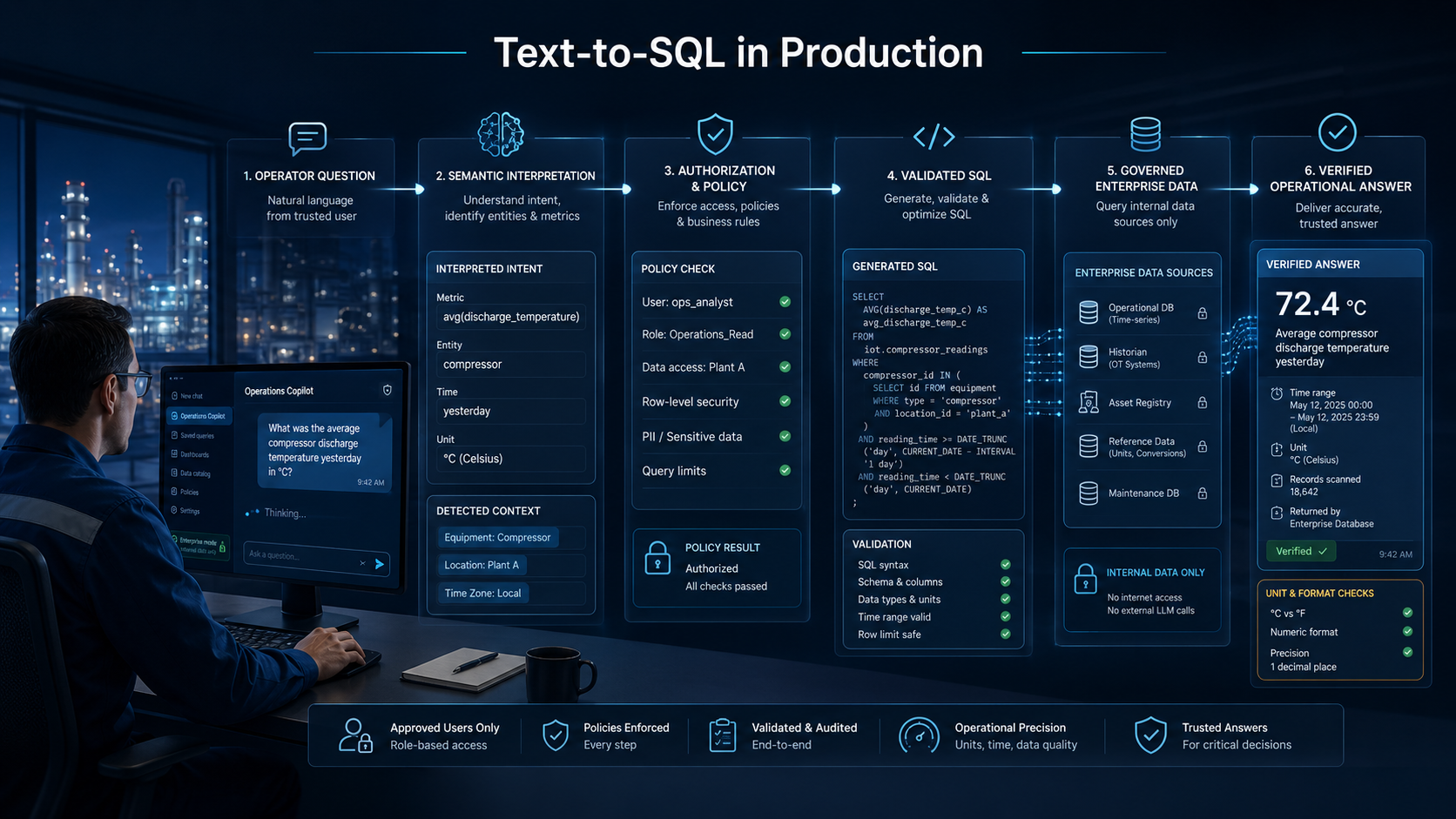
1. Semantic Ambiguity Appears Before SQL Generation
The first production problem is not usually SQL syntax.
It is language.
Operators use expressions whose meaning depends on role, location, operation, and business context.
Consider:
What is today's available volume?
Before generating a query, the system must resolve:
- Which facility?
- Which product?
- Which storage location?
- Gross or net volume?
- Measured or calculated volume?
- Physical stock or commercially available stock?
- Calendar day or operational day?
- Should committed quantities be excluded?
- Which unit should be used?
- Which quality-adjustment rules apply?
A language model can generate flawless SQL against the wrong interpretation. This is dangerous because the result often looks plausible.
The system should not hide ambiguity behind a confident answer. It should make ambiguity visible.
A safer response might be:
I found three definitions of available volume. Do you mean physical inventory, uncommitted inventory, or quality-adjusted operational inventory?
That may feel less impressive than an immediate answer, but it is substantially safer.
In production, clarification is not friction. It is a control.
A Semantic Layer Helps
A reliable platform needs business concepts that are independent of raw table and column names.
Instead of teaching the model that qty_avl_adj matters, define what adjusted available quantity means:
- source systems;
- calculation rules;
- units;
- exclusions;
- freshness requirements;
- ownership;
- authorized audiences;
- known limitations.
Text-to-SQL becomes more reliable when it operates over governed business concepts rather than reverse-engineering meaning from database metadata.
2. Authorization Cannot Be Added After Query Generation
A conversational interface changes how users access data, but it must not change what they are permitted to see.
Suppose an operator asks:
Show me all delayed shipments and their financial exposure.
The generated SQL may be valid, but the answer could combine operational data with commercially sensitive contract values the operator is not authorized to access.
Traditional applications often enforce authorization through predefined screens and APIs. Text-to-SQL removes many fixed paths. Users can express combinations of filters, joins, and aggregations that were never explicitly designed.
This increases the authorization surface.
Controls may be required at several levels:
- source;
- database;
- schema;
- table;
- column;
- row;
- business concept;
- output field;
- conversational context.
A user may view shipment status but not contract value. They may access one facility but not another. They may see records but not cross-business-unit aggregates.
The assistant also needs protection against indirect disclosure. A user without access to individual values might infer them through totals, differences, or narrow filters.
Policy Must Remain Outside the Model
Authorization should be resolved before execution and enforced independently of the language model.
A safer design combines:
- enterprise identity;
- role-based and attribute-based access;
- row- and column-level security;
- approved semantic entities;
- policy enforcement outside the model;
- output filtering;
- auditable access decisions.
The model can help construct a query. It should never decide whether the user is entitled to the result.
3. Schema Drift Can Produce Answers That Still Look Correct
Production systems evolve.
Columns are renamed. Tables are replaced. Pipelines move. New sources are introduced. A calculated field changes meaning. A unit previously stored in kilograms begins arriving in grams. A timestamp becomes UTC instead of local time.
A query created last month may still execute after one of those changes.
That can be worse than a query that fails.
A failed query creates an incident. A successful query against changed semantics creates a credible wrong answer.
Schema drift therefore includes more than structure:
- column and table changes;
- type changes;
- source ownership changes;
- unit changes;
- business-definition changes;
- calculation changes;
- freshness changes;
- quality-rule changes.
A production platform needs versioned metadata and explicit contracts between data producers and the conversational layer.
When a critical definition changes, the platform should know:
- what changed;
- when it changed;
- which semantic entities are affected;
- whether previous evaluations remain valid;
- whether related questions must be temporarily blocked.
In a high-risk environment, “temporarily unavailable due to a definition change” is better than a confident answer based on an obsolete assumption.
4. Query Validation Must Examine Intent, Not Only Syntax
A generated query can parse correctly and still be unsafe, expensive, or semantically wrong.
Before execution, validation should inspect:
- sources;
- selected fields;
- joins;
- filter scope;
- aggregation;
- date ranges;
- unit transformations;
- destructive operations;
- expected result size;
- estimated execution cost;
- authorization policy;
- business rules.
Read-only credentials are necessary, but insufficient.
A read-only query can still:
- scan billions of rows;
- overload a warehouse;
- expose restricted data;
- create misleading aggregates;
- apply an incorrect conversion;
- return stale records;
- mix incompatible units;
- join data at the wrong grain.
For adjusted operational volume, validation might require that the query:
- use the approved inventory view;
- filter by an authorized facility;
- select the latest certified measurement;
- apply the approved density and temperature adjustment;
- exclude allocated inventory;
- return the configured operational unit;
- preserve required precision;
- include the data timestamp.
Critical rules should be deterministic. They should not depend solely on probabilistic model judgment.
5. Evaluation Is More Than Comparing SQL Strings
A common development metric is:
Did the model generate the expected SQL?
That is useful, but insufficient.
Different SQL statements can produce the same correct result. A query that matches a reference statement can also become wrong when data or semantics change.
Evaluation should test the complete answer path.
Intent Interpretation
Did the system understand the operator's meaning?
Authoritative Source Selection
Did it use the approved source?
Query Correctness
Are joins, filters, dates, aggregations, and transformations correct?
Authorization
Did the workflow respect access boundaries?
Unit and Formatting Accuracy
Were units, conversions, precision, dates, and locale-specific formats correct?
Grounding
Can every material statement be traced to returned data?
Operational Usefulness
Does the response support the actual decision?
Uncertainty Behavior
Did the system ask for clarification when necessary?
Failure Behavior
Did it refuse when data was stale, unavailable, unauthorized, or unreliable?
A production evaluation set should include realistic and adversarial cases:
- ambiguous language;
- conflicting terminology;
- incomplete filters;
- stale data;
- schema changes;
- unauthorized requests;
- incompatible units;
- empty results;
- outliers;
- malformed values;
- complex follow-up questions.
The evaluation set must evolve with production usage. Real operator questions expose ambiguities that design teams rarely anticipate.
6. Hallucination Can Happen After the Database Returns the Correct Result
Text-to-SQL discussions often focus on invented tables or columns.
That is only one failure category.
The model may generate a correct query, receive correct rows, and misrepresent them in natural language.
For example:
| Product | Available quantity | Unit |
|---|---|---|
| Product A | 18,450.75 | m³ |
The assistant says:
Product A has approximately 18.5 million cubic meters available.
The query was correct. The explanation was not.
Other failures include:
- changing units during summarization;
- recalculating incorrectly;
- confusing percentages and absolute values;
- reversing an increase and decrease;
- inventing a cause;
- omitting a qualifier;
- describing stale data as current;
- merging values from different locations;
- presenting an estimate as a measurement.
For high-value numerical answers, free-form transformation should be minimized. Important values should pass through deterministic formatting and conversion functions.
A robust response also carries provenance:
Adjusted available volume: 18,450.75 m³
Facility: Terminal North
Data certified at: 14:25 local time
Source: Operational Inventory View v3.2
Excludes: Allocated and quality-restricted inventory
Traceability makes it harder for polished language to hide a wrong assumption.
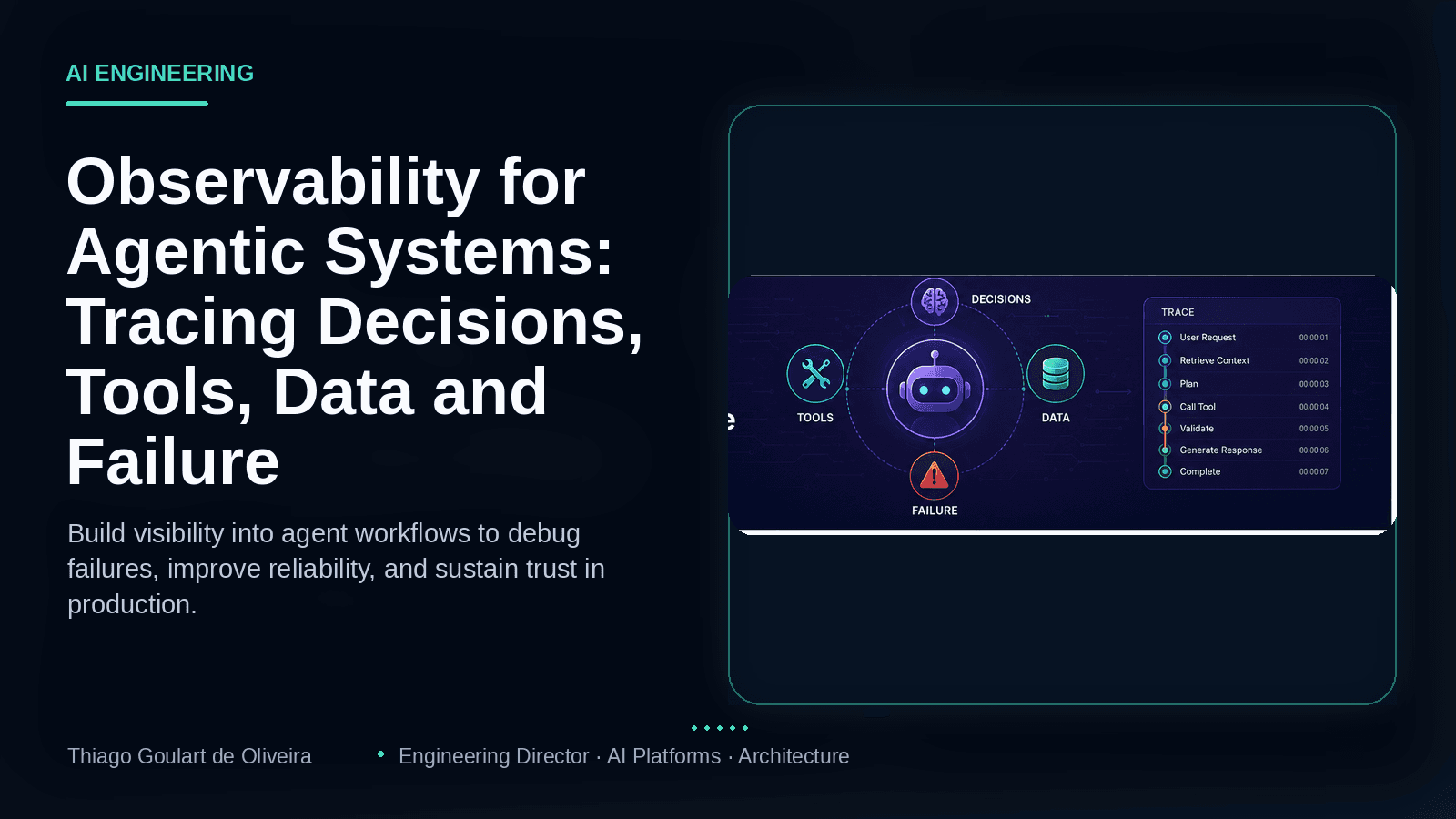
7. Observability Must Capture Decisions, Not Only Errors
Traditional monitoring focuses on latency, exceptions, CPU, memory, and availability.
A Text-to-SQL platform also needs visibility into how an answer was produced.
For each interaction, the system should be able to reconstruct:
- original question;
- interpreted intent;
- clarification;
- identity and authorization context;
- semantic entities;
- schema version;
- generated SQL;
- validation results;
- execution details;
- sources;
- row counts;
- freshness;
- transformations;
- final answer;
- risk classification;
- user feedback;
- escalation.
Logs may themselves contain sensitive data and require governance. The objective is accountable traceability, not unrestricted logging.
When an operator reports an incorrect answer, the team must distinguish among:
- misunderstood intent;
- incorrect metadata;
- invalid join;
- stale data;
- conversion error;
- authorization issue;
- summarization error;
- source-system defect.
Useful metrics include:
- clarification rate;
- validation rejection rate;
- unauthorized-request rate;
- execution success;
- answer correction;
- stale-data detection;
- operator acceptance;
- escalation;
- query cost;
- end-to-end latency;
- recurring ambiguity;
- performance by business domain and complexity.
The useful question is not how often the system answers. It is how often it produces an answer a qualified operator can safely use.
8. Latency Changes Operator Behavior
A ten-second demo can impress an audience. The same delay repeated throughout a shift can destroy adoption.
Latency accumulates across:
- intent classification;
- metadata retrieval;
- semantic resolution;
- authorization;
- SQL generation;
- validation;
- execution;
- result processing;
- response generation.
A slow workflow may cause operators to abandon the tool, repeat questions, return to legacy dashboards, or make decisions using older information.
Latency cannot be reduced by removing safeguards. The objective is not the fastest answer. It is the fastest safe answer.
Useful strategies include:
- cache approved metadata rather than uncontrolled answers;
- precompute common operational metrics;
- use governed analytical views;
- route simple questions through deterministic templates;
- classify complexity before expensive workflows;
- separate data retrieval and narrative generation;
- enforce query timeouts and scan limits;
- optimize data products for conversational access.
The interface should communicate controlled work:
Checking the latest certified inventory and applying the standard-volume adjustment.
A short explanation is better than an unexplained spinner.
9. Cost Grows Through Small, Repeated Decisions
The cost of a Text-to-SQL platform includes more than model tokens:
- metadata retrieval;
- vector search;
- model calls;
- warehouse compute;
- retries;
- validation;
- observability;
- evaluation;
- human review;
- incident investigation.
A poorly constrained question can scan years of high-volume data. A model can retry repeatedly after failures.
Controls should exist throughout the workflow:
- classify question complexity;
- use smaller models when appropriate;
- limit context to relevant metadata;
- enforce query budgets;
- estimate warehouse cost;
- reject unbounded queries;
- cache safe intermediate results;
- route common questions to governed metrics;
- monitor cost per successful answer;
- monitor cost by use case and domain.
Cost must also be assessed against business value. A more expensive answer can be justified for a high-value decision. The same cost may be unacceptable for a routine question that a governed metric can answer.
10. Human Escalation Is Part of the Product
In operational systems, escalation is a safety mechanism.
The assistant should stop when:
- multiple valid interpretations remain;
- the authoritative source is unavailable;
- freshness exceeds the permitted threshold;
- required fields are missing;
- systems conflict;
- a conversion cannot be verified;
- access is insufficient;
- the result is outside normal ranges;
- the decision carries substantial financial or safety impact;
- confidence is below the required threshold.
A useful escalation provides structure:
I cannot confirm the adjusted available volume because the latest quality measurement has not been certified. The physical inventory is available, but producing an adjusted value would require an unverified density reading.
Suggested next step: Contact Quality Operations or retry after certification.
The assistant should never compensate for missing evidence by inventing certainty.
The Production Architecture Is More Than an LLM Connected to a Database
A dependable platform requires controlled layers:
- Approved data products — curated views and governed analytical models.
- Semantic definitions — explicit business concepts, units, calculations, ownership, and freshness.
- Identity and policy enforcement — external to the model.
- Controlled query generation — only relevant and permitted metadata.
- Deterministic validation — critical rules and conversions.
- Safe execution — read-only connections, timeouts, limits, and cost controls.
- Grounded response generation — preserve units, precision, timestamps, and qualifiers.
- Traceability — sources and data timestamps visible.
- Continuous evaluation — real questions, changed schemas, and failure cases.
- Human intervention — clear paths for clarification, review, and escalation.
None of these layers is optional in a high-risk operational environment.
What Usually Breaks First?
The visible failure may be a wrong query, an incorrect unit, or a slow response.
The underlying failure usually happens earlier: the system lacks a controlled definition of truth.
It does not clearly know:
- what a business term means;
- which source is authoritative;
- who can access it;
- how current it must be;
- which transformations are permitted;
- when uncertainty is acceptable;
- when a human must take over.
A demo proves that a model can translate language into a query.
A production platform must prove something harder:
The complete path from human intent to operational answer is controlled, explainable, authorized, observable, and safe.
A production Text-to-SQL platform is not a chatbot with database access.
It is a governed decision-support system with a conversational interface.
The interface may look simple.
The engineering behind a trustworthy answer cannot be.